

Die-casting heatsinks and extruded heatsinks are both used for thermal management, but they are made in different ways and serve different design needs. Understanding the difference can help manufacturers choose the right solution for their products.
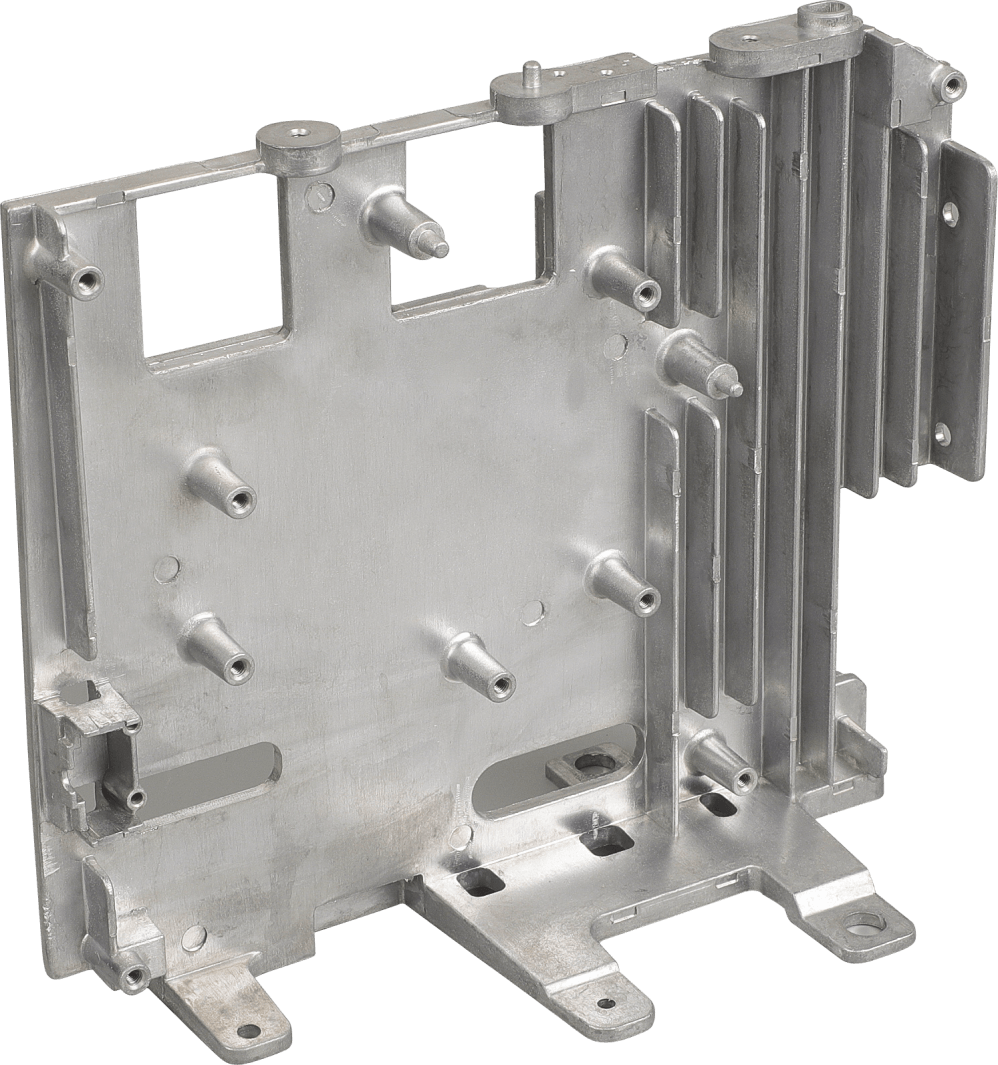
A die-casting heatsink is made by injecting molten metal into a mold under high pressure. This process allows complex shapes, integrated mounting features, and customized outer structures. An extruded heatsink is made by forcing heated aluminum through a die to create a continuous profile. The profile is then cut to the required length.
The biggest difference is design flexibility. Die-casting heatsinks can have complex three-dimensional shapes, curved surfaces, screw bosses, thin walls, and built-in structural features. This makes them suitable for products where the heatsink must also support the housing or mounting system. Extruded heatsinks are more limited because the cross-section stays the same along the full length. They are better for straight fin designs and simpler structures.
Extruded heatsinks are often used in applications with clear airflow direction, such as power supplies, amplifiers, and standard industrial equipment. Their straight fin structure is simple and efficient. Die-casting heatsinks are more suitable when the installation space is limited, the product shape is irregular, or multiple functions need to be integrated into one part.
Tooling and production strategy are also different. Die casting usually requires mold investment, so it is more suitable for medium- to high-volume production. Once the mold is ready, the process can produce large numbers of consistent parts efficiently. Extrusion can be a good choice for standard profiles and less complex thermal designs.
In terms of material, both types are often made from aluminum. Extruded aluminum may offer higher thermal conductivity in some cases, but real cooling performance depends on more than material alone. Surface area, fin design, airflow, contact quality, and product layout all affect final performance.
Another advantage of die-casting heatsinks is integration. They can combine thermal and mechanical functions in one component, reducing the need for extra brackets, covers, or secondary parts. This can simplify assembly and improve product appearance.
Die-casting heatsinks are common in LED lights, automotive electronics, telecom devices, and custom industrial products. Extruded heatsinks are widely used in standard power electronics, control systems, and equipment that uses linear cooling profiles.
In summary, die-casting heatsinks are better for custom shapes and integrated designs, while extruded heatsinks are better for simple profiles and straightforward cooling structures. The right choice depends on product design, production volume, budget, and thermal requirements.